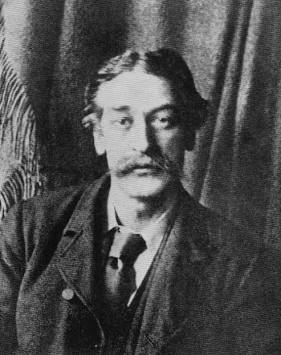
 Edmund Gurney (March 23, 1847 – June 23, 1888) was a British psychologist, music theorist, and psychical researcher best known for his pioneering work on hypnosis and
telepathy, as well as his connection to elite Victorian intellectual circles.
Edmund Gurney (March 23, 1847 – June 23, 1888) was a British psychologist, music theorist, and psychical researcher best known for his pioneering work on hypnosis and
telepathy, as well as his connection to elite Victorian intellectual circles.Queer Places:
University of Cambridge, 4 Mill Ln, Cambridge CB2 1RZ
Extra-Mural Cemetery, Lewes Road, Brighton, Brighton and Hove Unitary Authority, East Sussex BN2 3QB England
Edmund Gurney (March 23, 1847 – June 23, 1888) was a British psychologist, music theorist, and psychical researcher best known for his pioneering work on hypnosis and
telepathy, as well as his connection to elite Victorian intellectual circles.
Born into a prominent family, Gurney was educated at Trinity College, Cambridge, where he was elected a Fellow. He initially pursued music, writing The Power of Sound (1880), a foundational text in musical aesthetics. He later studied medicine and law before shifting his focus to the emerging field of psychology and psychical research.
In 1882, alongside Henry Sidgwick, Frederic W.H. Myers, and others, Gurney co-founded the Society for Psychical Research (SPR). He served as the society's first principal investigator and honorary secretary, compiling Phantasms of the Living (1886)—a landmark two-volume study analyzing telepathic hallucinations and experimental hypnosis.
Gurney died unexpectedly at age 41 in Brighton in 1888 from an overdose of chloroform, which he used for chronic neuralgia; whether it was accidental or suicide remains debated.
Gurney moved within an influential network of Cambridge intellectuals—including Frederic W. H. Myers, Arthur Thomas Myers, Henry Sidgwick, and Arthur Sidgwick—whose close-knit bonds formed part of late-Victorian homosocial and early homosexual subcultures.
Gurney was deeply embedded in the Cambridge Apostles atmosphere and SPR leadership, environments characterized by intense romantic friendships and intellectual intimacy among men.
Scholars of 19th-century gender and sexuality frequently highlight this group because several of Gurney's closest collaborators had explicit ties to early queer history:
Frederic W. H. Myers had youthful romantic and sexual relationships with Arthur Sidgwick and John Addington Symonds (one of Britain's earliest defenders of same-sex love).
Arthur Sidgwick was an active member of homosocial literary and educational circles.
John Addington Symonds collaborated closely with the wider SPR network while researching Greek pederasty and early sexology.
While Gurney himself was married (to Kate Sibley in 1877) and left no explicit personal records documenting same-sex romantic activity, his career, intellectual output, and personal life were thoroughly intertwined with the key figures who laid the groundwork for early LGBTQ+ advocacy and Victorian queer social history.
References:
 Intimate Friends: Women Who Loved Women, 1778-1928 by Martha Vicinus |
Other references:
Support this project
This website is a passion project researched, developed, and funded entirely by me. If you find the content valuable and would like to help support the ongoing research and hosting costs, any contribution is deeply appreciated.
Thank you for keeping this independent resource alive!
My books on Amazon: Elisa Rolle's books